Showing posts with label English Speaking Basics. Show all posts

Friday, February 28, 2020

Pronouns


A pronoun takes the place of a noun. 

Example story:

Mary is one of the heads of the ToJi Corporation. Mary works with Mr. James and Mr. James' son Tom. Mr. James and Mr. James' son Tom are experts in biochemistry. Mary, Mr. James, and Tom researched and invented a drug for cancer treatment. 

If the story above is written using pronouns:

Mary is one of the heads of the ToJi Corporation. She works with Mr. James and his son Tom. He and his son Tom are experts in biochemistry. They researched and invented a drug for cancer treatment. 

Personal Pronouns


Personal pronouns refer to a person:


  • I go to school.
  • You are a student.
  • They are Koreans.
  • He works here.
  • We gave her food.

The word ‘it' refers to an object:


  • I drank it.
  • It is big.
  • They cut it into halves.

Sunday, October 13, 2019

Big Family

Characters


Grand Mother, Father, Mother, Child and Daughter


Grand Mother : Son, What are you talking to Gomathi?Father : I am showing her the moon.Daughter : When did it rise?Father : It had risen one hour before. It is a full moon day.Daughter : Can we see the moon during No-Moon Day?Father : During Amavasai the sky will be completely dark.Child : What is the white ball through the window?Mother : No. It is not a ball. It is the full moon.Child : It is very beautiful.Child : Grandpa is calling us for supper. We shall go.


Words to Know


  1. Talking
  2. Showing
  3. Rise
  4. Dark
  5. Completely
  6. Ball
  7. Window
  8. Beautiful
  9. Supper
  10. Grandpa

Saturday, July 21, 2018

Methods for Improving Your Spoken English

14 Methods for Improving Your Spoken English Without a Speaking Partner


1. Think in English.

Sometimes the difficult thing about talking in a new language isn’t the language itself, but how you think about it.
If you think in your native language and then try to speak English, you’ll always have to translate between languages. Translating isn’t an easy thing to do! Even people fluent in two or more languages have trouble switching between languages.
The solution is to think in English.
You can do this anywhere, anytime. Try to use English when you’re thinking about your day, or when you’re trying to decide what food to order. Even try to use an English to English dictionary to look up words. That way you never have to use your native language and translate words. You’ll notice that when you think in English, it’s easier for you to speak in English.

2. Talk to yourself.

Whenever you’re at home (or alone somewhere else) you can practice your English with your favorite person: yourself.
If you’re already thinking in English, try speaking your thoughts out loud. Read out loud, too. Practice is practice, and even if you don’t have anyone to correct your mistakes, just the act of speaking out loud will help you become more comfortable speaking English.

3. Use a mirror.

Whenever you can, take a few minutes out of your day to stand in front of the mirror and speak. Choose a topic, set a timer for 2 or 3 minutes and just talk.
The point of this exercise is to watch your mouth, face and body language as you speak. It also makes you feel like you’re talking to someone, so you can pretend you’re having a discussion with a study buddy.
Talk for the full 2 or 3 minutes. Don’t stop! If you get stuck on a word you don’t know, try expressing your idea in a different way. You can always look up how to say that word after the 2-3 minutes end. This will definitely help you find out what kinds of words or sentences you have trouble with.

4. Focus on fluency, not grammar.

When you speak in English, how often do you stop?
The more you stop, the less confident you sound and the less comfortable you become. Try the mirror exercise above, but challenge yourself to speak without stopping or stammering (taking pauses between your words) the entire time.
This might mean that your sentences won’t be grammatically perfect, and that’s okay! If you focus on speaking fluently instead of correctly, you’ll still be understood and you’ll sound better. You can fill in the correct grammar and word rules as you learn them better.

5. Try some tongue twisters.

Tongue twisters are series of words that are difficult to say quickly. One example is: “The thirty-three thieves thought that they thrilled the throne throughout Thursday.” Try saying this a few times! It’s not easy.
Word games like this will help you find the right placement for your mouth and tongue, and can even help your pronunciation. Y

6. Listen and repeat.

Do you watch TV shows or YouTube videos in English? Use them to improve your fluency. Choose a short part of a show and repeat it line by line. Try to match the tone, speed and even the accent (if you can). It doesn’t matter if you miss a few words, the important thing is to keep talking. Try to sound just like the native speakers on the show.

7. Pay attention to stressed sounds.

English uses stresses in words and sentences. That means you’ll need to stress, or emphasize, certain words and syllables (sounds) to give words and sentences different meanings.
Listen to where native speakers place the emphasis when they speak. Try to repeat it the same way.
This won’t only help you speak well, it might even reduce misunderstandings. Sometimes the placing the stress on the wrong syllable completely changes the word. The word ADdress, for instance, isn’t the same as the word adDRESS. ADdress refers to a physical location where someone lives, and adDRESS means to formally speak to a group of people.
Learn to hear the difference!

Saturday, June 2, 2018

Basic English Grammar Rules

Some of the most basic and important English grammar rules relate directly to sentence structure. These rules specify that:
  • A singular subject needs a singular predicate.
  • A sentence needs to express a complete thought.
Another term for a sentence is an independent clause: 
  • Clauses, like any sentence, have a subject and predicate too. If a group of words does not have a subject and predicate, it is a phrase.
  • If a clause can stand alone and make a complete thought, then it is independent and can be called a sentence.
  • If clauses do not express a complete thought, they are called dependent clauses. An example of a dependent clause, which is not a sentence, is “when I finish my work.” A dependent clause needs an independent clause to make it whole.

Subjects and Predicates

Basic to any language is the sentence, which expresses a complete thought and consists of a subject and a predicate.
  • The subject is the star of the sentence; the person, animal, or thing that is the focus of it. 
  • The predicate will tell the action that the subject is taking or tell something about the subject.

Saturday, March 31, 2018

Interrupting

    Interrupting politely
      Excuse me,
      Pardon me,
      Sorry to interrupt,
      May I interrupt (for a minute)?
      Can I add something here?
      I don't mean to intrude, but . . .
      Could I inject something here?
      Do you mind if I jump in here?
    Getting back to the topic
      Anyway,
      Now, where was I?
      Where were we?
      What were you saying?
      You were saying . . .
      To get back to . . .

Friday, March 30, 2018

Clarifying

    Clarifying your own ideas
      In other words,
      What I mean is . . .
      What I'm trying to say is . . .
      What I wanted to say was . . .
      To clarify,
    Asking for Clarification
      What do you mean (by that)?
      What are you trying to say?
      What was that again?
      Could you clarify that?
    Clarifying another's ideas

      You mean . . .

      What you mean is . . .

      What you're saying is . . .

      (I think) what she means is . . .

      What he's trying to say is . . .

      If I understand you, (you're saying that . . . )
      If I'm hearing you correctly,
      So, you think (that) . . .
      So, your idea is . . 

Sunday, March 25, 2018

Elaborating

    Asking for Elaboration
      Could you elaborate (on that)?
      Could you tell me a little more about it?
      Could you give (me) some details?
      Could you fill me in on that?
      Could you expound on that?
      What else can you tell us (about that)?
      Is there anything else you can tell us?
      Is there more to it?
    Elaborating
      To elaborate,
      To give you more information,
      Let me explain.
      Let me elaborate.
      Let me tell you a little more (about it).
      Let me give you some details.
      What's more,

Friday, March 23, 2018

Discussion Techniques

    Opening a discussion
      To begin with,
      We need to discuss . . .
      determine
      find out
      Let's start by (V ing)
      We'll start by (V ing)
      The problem here is . . .
      issue
      question
      The important thing (here) is . . .
      The main thing we need to discuss is . . .
      Let's look at . . .
      It looks like . . .
      It appears that . . .

    Asking for input
      What do you think?
      How about you?
      How do you feel about that?
      Any ideas on that?

    Responding
      (That sounds like a) good idea.

      Sounds good.

      The problem with that is . . .
      That raises the issue of . . .
      brings up

Friday, March 9, 2018

Common food groups


Different types of meat

 Most common meats = lamb or mutton (mutton = sheep ), pork or beef
Different types of poultry

 Most common poultry = chicken, turkey, goose, duck, pheasant 
different types of game

 Most common game = rabbit, hare, partridge, pheasant
Different types of seafood

 Most common seafood = fish, prawns, shrimps, lobster, scallops, mussels, crab
Different types of vegetables

 Most common vegetables broccoli, carrots, cabbage, cauliflower, beans, garlic, green onions, red onions
different types of friut

 Most common fruit apples, orange, banana, watermelon, strawberries, plums,


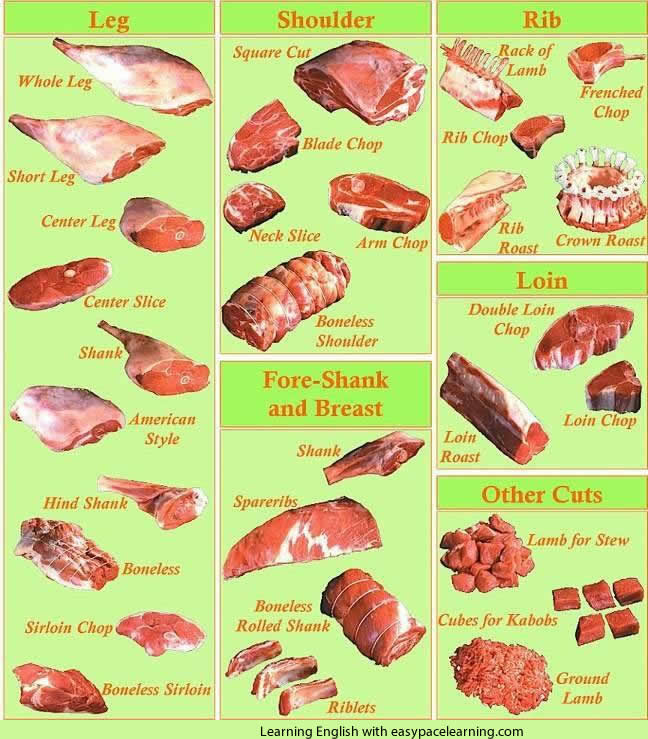
Different parts of meat vocabulary

Learning about different parts of meat

Ways food is cooked

boiled –
Mrs Jones boiled the rice.
The potatoes were cooked in boiled water.
steamed –
Mrs Smith steamed the fish over a pan of boiling water
fried / sauteed –
cooked in oil in a wok or a frying pan
Mr bean loves to eat fried egg in the morning.
Mr Jones fried the bacon for is sandwich 
stir-fried –
fried fast using a wok in hot oil
pan-fried –
fried in a frying pan
Mr bean fried the steak in the frying pan.
steak can be pan-fried. 

Sunday, January 21, 2018

Shock and disbelief

Expressing shock and disbelief

It is sometimes difficult to say how you feel in unexpected situations, such as natural disasters, bad news .., especially when you feel sad.
Here's a list of some common expressions to help you express
  • shock
  • and disbelief.

Shock:

I was
shocked to hear…
stunned by...
taken aback by…
... came as
a complete shock.
I'm in
Examples:
  • I was shocked to hear the news.
  • I was stunned / taken aback by the news
  • I was completely taken aback by his behavior.
  • I was just stunned by her clothes.
  • The news came as a complete shock.
  • We're all in complete shock.

Saturday, January 20, 2018

Telling The Time

How to tell the time in English?

There are two common ways of telling the time in English. For 2:40 you can use one of these two ways.
  • Digital: the easier way - "Two forty "
  • Classical: you say the minutes first then the hour - "twenty to three"
Here are the different ways to ask for and tell the time.

Asking about the time:

What
time is it?
time do you make it?
's the time?
Have you got
the right time?

Saturday, January 13, 2018

Making Offers

How to make offers in English?

It is common that English speakers make offers in conversations in order to be polite and helpful. When they do so they use these expressions:

Can I… ?
Shall I… ?
Would you like … ?
How about ...?
English learner must be able to make offers as well as accept or reject them. The following are useful expressions to do so.

Making offers:

Can
I
help you?
Shall
get you some juice?
Would you like
a glass of water ?
How about
some pizza?

Examples:

  • "Can I help you?"
  • "Shall I open the window for you?"
  • "Would you like another cup of coffee?"
  • "Would you like me to clean the board?"
  • "How about a juice? "

Remember:

  • Shall, can and will are followed by the verb without to. 
    Example:
    "Can I help you?"
    "Shall I bring you the mobile phone?
  • Shall is more formal than can.
  • Would you like… is followed either by a noun, or by the verb with to.
    Example:
    "Would you like some tea ?"
    "Would you like to drink some coffee?

Talking About Favorite Things

Talking about favorite things

When you talk about your favorite things you talk about the best liked or most enjoyed things.
Examples:
  • "What's your favorite color?" "Green."

Study the dialogue:

Leila is talking to her new friend Cathy:
Leila:What kind of films do you like best?
Cathy:Science fiction. And you?
Leila:Comedy. And who's your favorite actor?
Cathy:Tom Cruise.
Leila:I like Robert de Nero most.

Asking about favorite things:

  • What's your favorite sport?
  • What sport do you like best?
  • What sport do you like most?
  • What kind of sport do you like best?
  • Who's your favorite football player?

Sunday, December 31, 2017

Asking For And Giving Permission

When you ask for permission to use something that belongs to someone else you have to do your best to be polite. It is desirable to use the word "please."

Asking for Permission:

  • Can I go out, please?
  • May I open the window, please?
  • Please, can I have a look at your photo album?
  • Please, may I taste that hot spicy couscous dish?
  • Do you mind if I smoke?
  • Would you mind if I asked you something?
  • Is it okay if I sit here?
  • Would it be all right if I borrowed your mobile Phone?

Giving Permission:

  • Yes, please do.
  • Sure, go ahead.
  • Sure.
  • No problem.
  • Please feel free.

Refusing to give permission:

  • No, please don’t.
  • I’m sorry, but that’s not possible.
  • I'm afraid, but you can't.

Saturday, December 30, 2017

Talking about ability

How to express ability

To express that someone has the power or skill to do something, can and be able are used.
Examples:
  • I can't help you.I am busy.
  • I'm unable to help you.
  • When I was young I was able to earn my living pretty well; I could work hard. Now I can't. I'm too old.
  • I can stand on my head for five minutes.
  • Can you speak Arabic?
  • Yes, I can.

Expressing ability

In the present:

Express ability in the present as follows:
  • I can speak good English.
  • I can't stand on my head.

In the past

Express ability in the past as follows
  • I was unable to visit him.
  • I couldn't eat at all when I was ill.

In the future

Express ability in the future as follows
  • I will be able to buy a house when I get a good job.
  • The teacher can assist you after class if you have any questions.

Things to remember:

  • Can is always followed by an infinitive without "to."
    Examples: 
    I can ride my bike and I can drive a car, but I can't drive a lorry. 

Sunday, December 24, 2017

Introducing yourself and other people

There is a range of ways to introduce yourself and people.

Introducing yourself:

Here are expressions to introduce yourself:
  • My name is ...
  • I'm ....
  • Nice to meet you; I'm ...
  • Pleased to meet you; I'm ...
  • Let me introduce myself; I'm ...
  • I'd like to introduce myself; I'm ...

Introducing others:

Here are expressions to introduce others:
  • Jack, please meet Nicolas.
  • Jack, have you met Nicolas?
  • I'd like you to meet Liza.
  • I'd like to introduce you to Betty.
  • Leila, this is Barbara. Barbara this is Leila.

Useful responses when introducing yourself or other people:

  • Nice to meet you.
  • Pleased to meet you.
  • Happy to meet you.
  • How do you do?

Dialogue:

Alex is talking to the new manager and his assistant. Notice how they introduce themselves:
Alex:Hi! My name is Alex Litterman, the new manager.
William:Hi! I'm William O'Brian. Nice to meet you, Mr Alex Litterman.
John:William, please meet Mr Steve Lynch, my assistant
Jack:How do you do?
Nicolas:How do you do?

Friday, December 22, 2017

Greeting

There are different ways to greet people:

Greeting means welcoming someone with particular words or a particular action.
When meeting people formally for the first time, we greet by shaking hands and saying "How do you do?" or "Pleased to meet you."
"How do you do?" isn't really a question, it just means "Hello".
When young people meet informally they sometimes greet and say "Give me five!" and slap their hands together (high five).
Generally we do not greet by shaking hands with people we know well. We greet by just saying 'hi' or 'hello'
Here are some expressions you can use to greet people.

Greeting

  • Hi, hello.
  • Good morning, good afternoon, good evening.
  • How are you?
  • How are you doing?
  • How do you do?

Responding to greeting

  • Hi, hello.
  • Good morning/Good afternoon/Good evening.
  • I'm fine thank you (thanks)/Okey! Thank you (thanks)/Can't complain/Not bad.
  • How about you?/And you?
  • How do you do?

Things to remember about greeting:

When you greet someone and say:
"How do you do?"
this isn't really a question, it just means "Hello".

Sunday, December 17, 2017

Examples of English Tenses

ExplanationsPresent Simple
Action that is repeated every Friday. Habitual action.I visit my uncle every Friday
Facts that are believed to be true. GeneralizationsCats hate mice.
The sun rises in the morning.
Scheduled events in the near futureThe plane takes off at 10 o'clock tonight
ExplanationsPresent Progressive
Action that takes place now / at the momentI am working on my computer
Near futureI am leaving tomorrow
ExplanationsPresent Perfect
To talk about experiencesI have been to Italy.
Past action that has the result in the present.She has read that book.
Action which started in the past and continued up to now.I have lived in this town for 12 years.
ExplanationsPresent Perfect Progressive
To show that something started in the past and has continued up until now.He has been sleeping for the last 3 hours
To talk about an action that started in the past and stopped recently.The grass is wet because it has been raining all day long.
To talk about an action that started in the past and is continuing now.I have been watching TV for 2 hours / since you left.
ExplanationsPast Simple
Completed action in the past.She left yesterday.
To talk about an action that started in the past and stopped recently.She woke up, had a shower and left.
To talk about an action that started in the past and is continuing now.If I had a million dollar, I would help the poor.
An action taking place in the middle of another action.She was playing when the accident occurred.
ExplanationsPast Progressive
Actions happening at the same time in the past.He was reading a newspaper while his wife was preparing dinner.
Interrupted action in the past.Sh was reading a book when the light went off, had a shower and left.
ExplanationsPast Perfect Simple
Completed action before another action in the past.She had left when I arrived.
ExplanationsPast Perfect Progressive
To show that something started in the past and continued up until another action stopped it.They had been playing soccer when the accident occurred
To show that something started in the past and continued up until another time in the past.I had been living in that town for ten years before I moved to New York.
We use the Past Perfect Continuous before another action in the past to show cause and effect.I was so tired. I had been working for 6 hours.
ExplanationsFuture  Simple
Instant decisionsI've left the door open; I'll close it.
We use the simple future , when we predict a future situationShe'll pass the exam. She's hardworking.
We use the simple future with: "I (don't) think...", "I expect...", "I am sure...", "I wonder...", "probably".It will probably rain tonight
Conditional sentence type oneIf I have enough time, I'll watch the film.
ExplanationsFuture Progressive
Action that will be taking place at some time in the future.When you arrive, I'll be sleeping .
ExplanationsFuture Perfect
Completed action before another action in the pastBy tomorrow, I will have finished the work.
ExplanationsFuture Perfect Progressive
It is used to show that an action will continue up until a particular event or time in the future.She will have been working for over 8 hours by the time her children arrive.